DAY ONE PROPOSAL · SPORTS · TOURISM · JOBS
An NBA Team for Jacksonville
Dear Commissioner Silver and the NBA
On my first day as mayor, I would request a formal introductory meeting with Commissioner Adam Silver and the appropriate NBA expansion and market-development staff. Jacksonville would arrive with questions, evidence and humility—not a demand that the league accept an unsupported promise.
Our case would be that Northeast Florida can become a distinctive basketball market built around families, military communities, youth development, tourism and year-round downtown activity. We would commission independent studies of demand, ownership structures, arena requirements, transportation, operating cost and the effect on existing venues and teams.
I support studying a people-centered ownership model. Direct city ownership may conflict with NBA rules, Florida law, financing limits or sound risk management, so the study must also examine a community trust, locally led private ownership, broad-based minority investment and enforceable community-benefit agreements. The goal is public value without hiding risk from taxpayers.
Jacksonville asks for the opportunity to demonstrate readiness. If the evidence supports the case, we will build responsibly. If the evidence does not, we will publish it and strengthen basketball through youth, college, G League, WNBA and major-event opportunities. Together, we win by respecting both ambition and facts.
A seven-phase execution plan
Phase 1 · Establish the evidence
Create a Council-reviewed feasibility scope; hire independent market, legal, finance, venue and transportation specialists through competitive procurement; publish assumptions; survey season-ticket and corporate demand without representing interest as a binding sale; and establish clear stop/go standards.
Phase 2 · Open league and ownership conversations
Send the Dear NBA letter, request meetings with league leadership, learn the NBA’s actual expansion criteria, identify qualified ownership groups, evaluate league-compliant community participation models, and document what Jacksonville must prove before advancing.
Phase 3 · Test the venue network
Compare renovation and new-construction scenarios; identify which uses belong in an NBA arena and which belong in the performing arts center; model calendars, loading, security, acoustics, parking, transit, hotels and neighborhood effects so one proposal does not undermine another.
Phase 4 · Build the athlete-performance pathway
Study a connected sports-performance and medicine campus with courts, strength and conditioning, rehabilitation, sports science, nutrition, mental-health support, coaching education and youth clinics. Access for visiting elite athletes must coexist with scheduled community and school programming.
Phase 5 · Protect public value
Publish capital and operating costs, land commitments, debt risk, maintenance obligations and opportunity costs. Any incentive or public participation must be tied to enforceable jobs, local purchasing, youth access, neighborhood protections and independent annual reporting.
Phase 6 · Grow toward readiness
Host NBA preseason, G League, WNBA, college, international and youth events where feasible; improve hotel capacity and visitor service through private investment; strengthen local basketball culture; and use verified attendance, visitor spending and sponsorship results to demonstrate demand.
Phase 7 · Submit only when Jacksonville is ready
Advance a formal bid only if the league signals an opportunity and independent evidence supports it. Present ownership, arena, financing, security, transportation, hotel and community-benefit plans as one documented package, with every required approval identified.
The 30-point Jacksonville case
- Jacksonville is a major Florida city with a large regional population
- Northeast Florida offers a distinct geographic market
- The city has deep professional-sports loyalty
- Jaguars support proves fans can build a durable identity
- AEW and major wrestling events demonstrate event demand
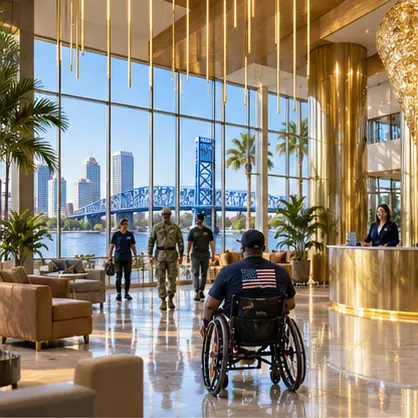
- Military families and veterans broaden the fan community
- Youth basketball can become a year-round development pipeline
- Regional colleges create partnership and ticket opportunities
- A downtown team can support restaurants and hospitality
- An NBA calendar fills dates across fall, winter and spring
- Basketball attracts domestic and international visitors
- A team can expand national media visibility
- Corporate partnerships can grow with the market
- Premium seating and sponsorship demand must be tested transparently
- Public transit planning can connect neighborhoods to events
- A practice facility can support camps and community programming
- Women’s and girls’ basketball partnerships can expand access
- Sports medicine and performance careers can grow locally
- Arena operations create hospitality and skilled-trade work
- Local vendors can compete through transparent procurement
- The team can complement—not displace—the Jaguars
- Cross-promotion can strengthen AEW and other arena events
- All-Star and international events can add tourism demand
- Jacksonville’s airport and interstate access support regional travel
- The riverfront can provide a distinctive visitor experience
- A community-benefits agreement can protect public value
- Independent feasibility work can test realistic demand
- Phased planning can prevent premature taxpayer commitments
- Public reporting can show costs, risks and projected returns
- Jacksonville offers the NBA an ambitious, community-centered partner
10 steps: how the performing arts and event district draws people together
- Complete independent market, site and operating studies
- Design flexible performance and event spaces around acoustics and access
- Connect the district to transit, hotels, restaurants and the riverfront
- Reserve affordable community dates and local-artist pathways
- Build promoter, touring, convention and sports partnerships
- Create hospitality packages linking performances with neighborhoods
- Develop safe late-night transportation and public-safety plans
- Use measurable naming-rights, sponsorship and philanthropic agreements
- Publish construction, operations and community-benefit scorecards
- Market Jacksonville nationally while keeping local culture at the center
A flexible riverfront district can serve concerts, theater, comedy, community performances, conferences and selected sporting events. It can complement the Jaguars, AEW and existing Jacksonville venues through coordinated calendars and visitor packages, but it must not pretend one building can host every use or solve loneliness alone. The strongest benefit comes from regular affordable programming, public space and connections that help residents meet, create and belong.
The performance center and athlete-performance campus would be connected by programming and visitor strategy, not treated as the same building. Artists and athletes both depend on disciplined practice, health, recovery, coaching and stages worthy of their work. Jacksonville can coordinate hotels, transit, public safety, dining, waterfront activity and event calendars so a major performance, tournament or game creates benefits across the city.
100 steps toward the City of Tomorrow
These steps are a sequence for study, partnership and delivery. Many require Council approval, independent agencies, private partners or state and federal action.
- Listen and measure: Publish a city baseline
- Listen and measure: Hold district listening sessions
- Listen and measure: Map service complaints
- Listen and measure: Audit project delays
- Listen and measure: Measure permitting time
- Listen and measure: Review public-safety response
- Listen and measure: Survey youth needs
- Listen and measure: Survey senior needs
- Listen and measure: Map veteran services
- Listen and measure: Publish findings
- Fix essentials: Prioritize potholes
- Fix essentials: Repair dangerous sidewalks
- Fix essentials: Address drainage hot spots
- Fix essentials: Advance septic phaseout
- Fix essentials: Improve street lighting
- Fix essentials: Clean illegal dumping
- Fix essentials: Maintain parks
- Fix essentials: Improve bus stops
- Fix essentials: Protect emergency routes
- Fix essentials: Report completion
- Build opportunity: Create apprenticeship partnerships
- Build opportunity: Expand youth summer jobs
- Build opportunity: Simplify permit guidance
- Build opportunity: Open small-business help desks
- Build opportunity: Improve vendor access
- Build opportunity: Promote first-time homebuyer education
- Build opportunity: Support neighborhood retail
- Build opportunity: Recruit responsible employers
- Build opportunity: Tie incentives to results
- Build opportunity: Publish job outcomes
- Strengthen community: Launch violence-prevention partnerships
- Strengthen community: Support mental-health response
- Strengthen community: Coordinate veteran services
- Strengthen community: Develop homelessness prevention
- Strengthen community: Support food-distribution partners
- Strengthen community: Create senior connection programs
- Strengthen community: Expand sports and arts
- Strengthen community: Build neighborhood events
- Strengthen community: Recognize first responders
- Strengthen community: Measure trust
- Grow culture: Study the performing arts center
- Grow culture: Expand local stages
- Grow culture: Build artist pipelines
- Grow culture: Attract touring acts
- Grow culture: Support museums and history
- Grow culture: Promote multicultural festivals
- Grow culture: Develop film and media work
- Grow culture: Grow convention business
- Grow culture: Improve visitor wayfinding
- Grow culture: Publish tourism results
- Advance sports: Open an NBA feasibility process
- Advance sports: Contact NBA leadership
- Advance sports: Create an independent study commission
- Advance sports: Evaluate lawful ownership models
- Advance sports: Test arena demand
- Advance sports: Coordinate with Jaguars stakeholders
- Advance sports: Build AEW event partnerships
- Advance sports: Pursue NCAA events
- Advance sports: Study boxing and international events
- Advance sports: Protect athlete and public safety
- Modernize government: Publish appointments
- Modernize government: Publish salary methodology
- Modernize government: Create a debt dashboard
- Modernize government: Open contract records
- Modernize government: Map capital projects
- Modernize government: Track legislation impacts
- Modernize government: Set service standards
- Modernize government: Protect data privacy
- Modernize government: Improve digital access
- Modernize government: Report quarterly
- Protect the future: Improve water stewardship
- Protect the future: Reduce litter and pollution
- Protect the future: Plan resilient infrastructure
- Protect the future: Protect tree canopy
- Protect the future: Create safe bicycle connections
- Protect the future: Improve pedestrian crossings
- Protect the future: Coordinate land use and transit
- Protect the future: Maintain public assets
- Protect the future: Plan lifecycle costs
- Protect the future: Measure environmental results
- Finance responsibly: Use conservative revenue estimates
- Finance responsibly: Identify recurring operating costs
- Finance responsibly: Require legal review
- Finance responsibly: Require competitive procurement
- Finance responsibly: Limit unfunded promises
- Finance responsibly: Test public-private structures
- Finance responsibly: Publish risks
- Finance responsibly: Use independent audits
- Finance responsibly: Create stop/go milestones
- Finance responsibly: Protect reserves
- Deliver together: Assign accountable leaders
- Deliver together: Set public deadlines
- Deliver together: Invite bipartisan oversight
- Deliver together: Engage neighborhoods
- Deliver together: Work with employees
- Deliver together: Partner with business
- Deliver together: Correct failing projects
- Deliver together: Celebrate verified progress
- Deliver together: Prepare the next four-year plan
- Deliver together: Keep the promise to report
Political advertisement paid for and approved by Fitz Desprez, Republican, for Mayor.